
FDA approves expanded use of PET imaging agent
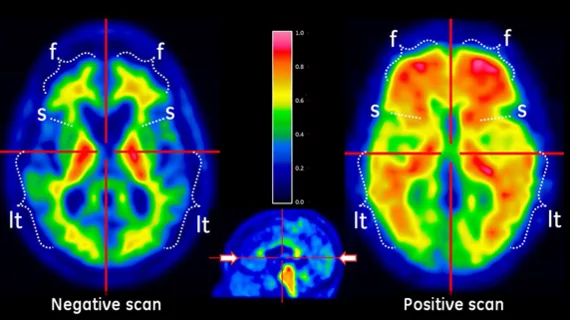
The U.S. Food and Drug Administration has approved the expanded use of GE HealthCare’s beta-amyloid imaging agent.
The healthcare giant shared the FDA’s decision on Vizamyl (flutemetamol F 18 injection) in an announcement Monday, calling the move “meaningful” for patients and families affected by neurodegenerative conditions.
“The inclusion of quantification and removal of the therapy monitoring limitation from the Vizamyl label is good news for healthcare providers and their patients, further enabling timely and appropriate care decisions,” Jit Saini, MD, chief medical officer of the pharmaceutical diagnostics division of GE HealthCare, said in a news release. “These changes pave the way for clinicians to expand their usage of Vizamyl, with meaningful implications for patients and their families—helping provide clearer answers, earlier diagnoses and enabling more personalized treatment strategies.”
Prior to this latest update, Vizamyl was used primarily as a tool to better visualize the accumulation of amyloid plaques in the brain. Now, the FDA has expanded its indications to include quantification and long-term monitoring of said plaques. The new indications open the door for more objective assessments and precision diagnoses. They also enhance providers’ ability to monitor treatment effectiveness, allowing them to adjust therapeutic strategies as needed.
“The use of quantification in amyloid PET imaging has steadily moved from research to clinical practice, where it can aid in more confident and accurate diagnosis,” Phillip Kuo, MD, PhD, section chief of nuclear medicine and director of theranostics at City of Hope National Medical Center in California, said in the same release. “Now quantification can also play a critical role in initiating and monitoring amyloid-targeted therapy for Alzheimer's disease and determining when it can be discontinued.”
What’s more, there also is an update to the agent’s use when diagnosing Alzheimer’s and the potential for cognitive decline to progress into the neurodegenerative condition. Prior to the update, the label limited these indications.
Learn more about the update here.

In addition to her background in journalism, Hannah also has patient-facing experience in clinical settings, having spent more than 12 years working as a registered rad tech. She began covering the medical imaging industry for Innovate Healthcare in 2021.